Sunday, October 03, 2010

Clever individuals do not make the group smarter

This post is a reaction to the recent article (more details) in which individual brainpower contributes little to collective smarts. Instead, it’s social awareness -- the ability to pick up on emotional cues in others -- that seems to determine how smart a group can be.

When we write something new in internet discussion, we just get negative voting usually, because people aren't prepared to get new generally valid information from individuals at all. Instead of this, the more irrelevant and widespread is the internet meme in your answers, the higher score you get - because it's considered "witty". Actually you're just repeating things, which most of people are already expecting to listen unconsciously. Most of people don't expect to hear some revolutionary ideas at all - instead of this, they're feeling confounded, if not confused when being confronted with them. It should be pointed out, the poor language skills are making the sharing of emotions much more difficult, then the sharing of logical information. In addition, socially successful people tend to ignore logical arguments.

In another words, if you want to convince people for something clever or good, you have to manipulate them for it emotionally... Emotions, emotions, emotions...

Unfortunately it works in both directions, as Joseph Goebels knew already.

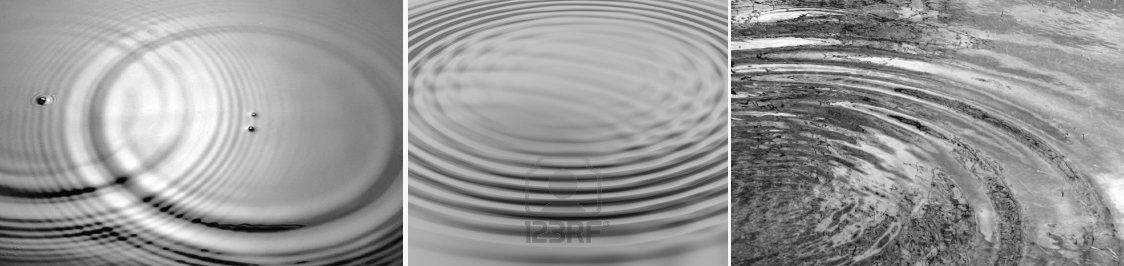
Actually, in dense aether theory a rather simple wave spreading model can be applied to this situation. This model renders human society like particle system, where every particle exhibits it's own surface gradient of information density, i.e. the intelligence. Theories, i.e. well accepted paradigms of human thinking correspond the density gradients at the water surface and the intelligent ideas are corresponding causual, i.e. tranverse waves in causual space, similar to ripples at the water surface. The emotional feelings correspond the longitudinal waves instead, similar to underwater sound waves.

The underwater waves are weaker but they're spreading in much faster way - whereas surface waves tend to bounce from every gradient of information density (i.e. intelligence). Very bright people are behaving like black holes in this model - they're collecting all informations freely, but their experience cannot be shared easily, because of total reflection mechanism at their surface gradient of intelligence density. With compare to it, very dumb people are behaving like mirror-like bubbles with respect to transverse waves instead: they're empty and they're even reflecting all causal information coming from outside.

A well known kind of symmetry between formal (IQ) and nonformal intelligence (EQ) exists here, though: dumb people are often quite sensitive emotionally and they can be manipulated easily in this way, whereas logical argument doesn't count very much for them. Instead of it, formally bright people are rather emotional nuts and they lack EQ and social skills often - compare the Sheldon Cooper character from The Big Bang Theory sitcom.

The only way, in which black hole can radiate it's information to outside is the gravitational waves, which appear like Howking radiation. This mechanism is relatively subtle though, which explains, why really intelligent ideas are propagating slowly to the rest of society. Nevertheless, they can be supported with sufficiently emotional propaganda. For example, string theory (which is actually quite incomprehensible for laymans) is promoted with shots of beauty violinists in play at Nova TV show.

Monday, September 27, 2010

Should journalists second guess the scientific truth?

This post is a reaction to recent article of Lubos Motl of the same name. It's not surprising, Motl supports his restrictive stance, regarding the rights to expression of private opinion from the side of journalists. But we shouldn't neglect the fact, with respect to climatic science Lubos is just an educated journalist like everyone else and he violates his own rules flagrantly, because he is trying to influent public meaning massively all the time. He is just trying to dispute rights of journalists to the same activity, which he dedicated most of his time - and because he uses Google Adsense on his blog, he's even earning some money for it like professional journalists.


In general, opinion of experts matters from intrinsic perspective only. But just because experts are specialized to narrow area of their private interest, they're not overmuch qualified in judging of their opinions in wider context - on the contrary, they tend to occupy their stances rather blindly - the more, the more they feel being an experts in given area. In this context the reading of articles The era of expert failure by Arnold Kling,  Why experts are usually wrong by David H. Freeman and Why the experts missed the crash by Phill Tetlock (in Czech) may be useful not only for Lubos Motl.

Niels Bohr: "An expert is a man who has made all the mistakes which can be made in a very narrow field".

Saturday, July 17, 2010

Higgs boson and fourth generation of quarks

This post is inspired by recent blog post of Tomaso Dorigo, who announced finding of Higgs boson with mass of about 150 GeV. By official media coverage it's just a rumour, that's got out of hand, as expressed by Fermilab's spokes'girl. More interestingly is, what's behind this rumour - and I don't mean over imagination or exploding ego of Mr. Dorigo, as Fermilab's Twitter post implies spitefully. Or do you really believe, Fermilab would give its official stance through Twitter? Such anonymous message is even much less reliable, then the original blogpost of Mr. Dorigo. But such way of  prematurely presentation of results and their vetoing indicates, how mainstream physics maneuvers between less or more opened tendency to announce findings as soon as possible for the sake of publicity and/or grant support ex una parte - and  the demonstrative expression of conservative skepticism on the other hand.


IMO Higgs boson is the same fuzzy unparticle stuff, like the virtual bosons responsible for Casimir force - their effective mass depends on surface geometry. Just at the case of Higgs boson the upper bound is limited by mass of top quark, so it can form a fuzzy signal, corresponding the dilepton channel of top quark decay, which was observed already. If even more massive quark exists, then its corresponding Higgs should indeed exist too and the whole concept of unique "God's particle" becomes fringe.

Mr. Dorigo himself putted the nail into coffin of Higgs boson by his previous announcement of fourth generation of quarks in 450 GeV range. Before finding of neutrino oscillation, the Standard Model contained 19 arbitrary dimensionless constants describing the masses of the particles and the strengths of the electroweak and strong forces. After the discovery of neutrino mass the new Standard Model requires 26 fundamental dimensionless constants, whose numerical values are, to the best of present understanding, arbitrary. Currently Standard Model is indeed incompatible with fourth generation of quarks or neutrinos, but thanks so high number of constants flexible enough to implement even higher particle generations. It's sort of regressive epicycle model keeping the Ptolemaic physics of modern era alive.

We can say, this finding is of approximatelly the same relevance like the previous finding of Higgs boson anounced (about three sigma in error level). And quess what? In this time the blog article was handled by NewScientist quite seriously and it got full coverage in media. The whole trick here is, most of physicists actually do not believe in concept of Higgs boson on background - despite the massive propaganda in CERN related media, the main purpose is to justify expensive experiments at LHC.

The title of recent another NewScientist article "In SUSY we trust: What the LHC is really looking for" (full version) illustrates clearly, physicists are aware of the conceptual problems of Higgs field concept. The article should be interpreted like: "Uhm, well, ... we actually don't believe, Higgs boson will be ever found at LHC - so we should concentrate to supersymmetry instead. ."

With respect to AdS/CFT duality the success or problems with particle search at Planck scale will be replicated/mirrored at cosmological scales (WIMPs detection) and vice-versa. Therefore it's not so strange, when dual situation recently appeared in media, when scientists started to speculate, (primordial) gravitational waves cannot be found at all due the "quantum-spread", which would render detectors of gravitational waves useless in the same way, like the LHC at quantum scale.

This is an example, how seemingly spontaneous scientific PR is basically working - layman public should trace subliminal messages of it for to get the realistic picture about opinion of this close sectarian community in the noise of PR journalism and propaganda.

Sunday, June 20, 2010

Is the Universe Leaking Energy?

This post is an reaction to recent ScientificAmerican article, in which the idea of mass/energy conservation law for Universe at large scales is impeached.

In Aether Wave Theory (AWT, dense aether theory) Universe is completelly random stuff, similar to nested dense fluctuations of hypothetical dense gas (aether) and its energy content is basically stable at large scales. The red shift in visible light should be compensated with blue shift for radio waves in analogy to dispersion of light at the water surface, i.e. nothing really expands, neither is losing its energy in fact. This doesn't mean, laws of Universe are 100% valid - the Universe just appears like random noise at both quantum, both cosmological scales - so we cannot observe any trend in it at sufficiently global scale.


Because the effect of Universe expansion compensates with contraction just at the wavelength about 2 cm (human observer scale), we're observing the lack of dark energy and dark matter phenomena just during observation of Universe in microwaves (compare the post about cosmological time arrow  and reddit comment).

Saturday, June 19, 2010

Quantum theorist explaining gravity is an ox(y)moron

This post is an reaction to ArXiv blog article New Quantum Theory Separates Gravitational and Inertial Mass. A typical problem with theoretical physicists is that they think that by presenting an alternative interpretation of a contradiction one can remove the contradiction.

Equations of quantum theory cannot describe gravity at all - on the contrary. By Schrödinger equation all wave packets of free particles should expand into infinity, not to collapse by gravity. We cannot switch 1 = 1 to 1 = -1 by any causal math because quantum theory reverses time arrow of general relativity.

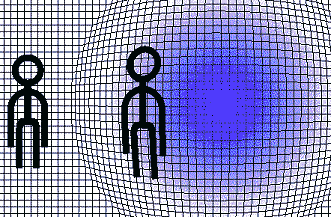
Observers inside and outside of gravitational field of massive bodies would perceive the same situation from perspective of general relativity and quantum mechanics
In AWT we can reconcile general relativity and quantum mechanics in two main ways:
  1. By using of particle simulation of nested density fluctuations inside of very dense gas. At the certain level of condensation the resulting solution inside of dense particle clusters would become close to general relativity, while the solution of outside them would become close to general relativity.
  2. We can solve wave equation in very high number of dimensions. After the solution in inner 3D slice of solution can be compared with quantum mechanics, in outer 3D slice it can be compared with general relativity.
Actually, in AWT the equivalence principle is violated by electrostatic or dipole forces, Casimir force etc. which are acting in extra-dimensions and nothing strange is about it. All these forces depend on different quantities, then just mass.