Showing posts with label metamaterial. Show all posts

Saturday, January 09, 2010

Universe and the rainbow of black holes

The substantial portion of AWT analogies is based on geometrical convergence of low-energy and high energy density phenomena. Recently metamaterial foam models of vacuum gained a popularity, thus sopporting the AWT model. Concept of foam is quite general in AWT and it can bring a most general understanding of things like rest mass of photon and dependence of photon dynamic mass to wavelength,  CPT symmetry breaking and general appearance of the observable Universe.


In AWT foam structure is an emergent result of incoming light dispersion by field of CMB fluctuations (i.e. gravitational waves) and as such it depends on observational perspective - the more, the more is distant from local human scale. From AWT perspective Universe is quite random environment, and extremely low portion of energy can spread through it in pure transversal way, thus raising the existence of causal observational perspective of human creatures. This perspective is sampling the causal portion of Universe in such way, it ignores dispersion of radiation nearly completely.

In real life such perspective corresponds the observation of heavy rain, where droplets get so densely arranged, they could be considered a foamy system consisting of mixture of density gradients with both positive, both negative curvatures. This geometry corresponds the geometry of density fluctuations inside of dense gas or supercritical fluid, the structure of CMB noise and the graviton foam expected in early Universe (in AWT graviton foam is the CMB noise observed from sufficiently distant perspective - compare the Big Bang model of AWT).

Under normal circumstances, the outer surfaces of rain droplets with positive curvature are more pronounced, so that normal dispersion prevails and one rainbow is formed. But at the case of heavy rain the anomalous dispersion on inner surfaces of rain droplets becomes dominant and the secondary rainbow is formed.

Alexander's band

Between primary and secondary bows the dark Alexander's band is formed. This dark are is named after Alexander of Aphrodisias, who first described it. It occurs due to the deviation angles of the primary and secondary rainbows. Both bows exist due to an optical effect called the angle of minimum deviation. Light which is deviated at smaller angles than this can never reach the observer. The minimum deviation angle for the primary bow is 137.5°. Light can be deviated up to 180°, causing it to be reflected right back to the observer. Light which is deviated at intermediate angles brightens the inside of the rainbow. The minimum deviation angle for the secondary bow is about 230°. The fact that this angle is greater than 180° makes the secondary bow an inside-out version of the primary. Its colors are reversed, and light which is deviated at greater angles brightens the sky outside the bow.

From AWT perspective the observation of primary rainbow corresponds the observation of large massive body, white hole surface in particular. The secondary bow corresponds the inner surface of foamy streaks of dark matter, consisting mainly of antimatter particles, heavily expanded during inflation. This perspective renders dark matter streaks as a symmetric phenomena of black hole surfaces. The Alexander band with no apparent dispersion itself corresponds the observation of space-time brane (a "transparent window"), forming cosmic space from insintric perspective. This model explains, the dispersion is restricted to narrow band, forming the physical surfaces of massive bodies, so that vacuum appears basically dispersion-less, but it appears dark (Olbers' paradox) at the price.
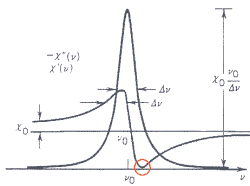
Závislost rychlosti a propustnosti disperze na vlnové délce
The absorption and refraction coefficients are related by Kronig-Kramers equations, named in honor of Ralph Kronig  and Hendrik Anthony Kramer. By these equations dispersion is volume phenomena of longitudinal waves and refraction the product of surface gradients, where transversal waves are involved. These functions are dependent to dimensional scale (i.e. wavelength) and phase shifted by half-period in causal space due the Lorentz/Wick rotation. Because hypersphere surface is first derivation of its volume, it basically means, dispersion curve is first derivation of absorption spectrum.

This simple dependence explains the symmetry breaking observed inside of our gradient driven reality, because the minimal speed (the position denoted by red circle on the above graph) of transversal energy spreading in dispersive spreading isn't exactly symmetric to position of absorption maximum. The requirement of minimal speed of transversal wave spreading follows from nearly infinite size of observable Universe. This effectively mean, symmetry violation is a consequence of the large space-time observed via density fluctuations of inhomogeneous environment and we can observe these fundamental connections even during rainy weather.

Tuesday, July 21, 2009

AWT and metamaterial character of vacuum

The modeling of vacuum by light spreading through material environment isn't completely new here. For example the recent experimental work demonstrated by sending of ultrashort pulses into foamy structure of optical fibers the blue-shifting of light at a white-hole horizon. Recently whole area of physics named transformation optics was established on analogy of physics of vacuum in gravity field to spreading of waves in media of variable refraction index (which was one of Einstein's "refractive approaches" to gravitational light bending and general relativity, by the way).

Metamaterial character of vacuum was proposed before two years and recent publication described the way, how to model structures like gravitational lensing, strange attractors, streaks of dark matter, photon sphere or event horizons of black holes by infrared waves spreading through porous GaInAsP metamaterial sponge. In context of existing theories these analogies are rather ad-hoced, but they've deep meaning in context of AWT, which describes vacuum as a dense system of particles, composed of nested fluctuations, which are having structure of fractal sponge or foam. Therefore the metamaterial nature of vacuum belongs between significant predictions of AWT.

The understanding the role of foamy structure of vacuum fluctuations (as manifested by CMB radiation, soliton character of gamma bursts or ZP energy) in metamaterial character of vacuum is quite easy, if we consider Aether concept. In inhomogeneous environment so called Rayleigh dispersion occurs, whenever the positive surface curvature of density fluctuations prevails. In such system the waves are dispersed (absorbed and refracted) the more, the shorter is their wavelength, because short waves cannot avoid obstacles so easily. From this reason both the absorption coefficient, both the refracting index of environment increases with increasing frequency of radiation - this is so called normal dispersion.

The materials with negative curvature fluctuations of Emental cheese structure are less common, but in such environment the relation of absorption and refraction curve is exactly as opposite, because in such environment the refraction index decreases with increasing frequency with compare to absorption, so we are talking about "anomalous dispersion" here.

The absorption and dispersion curves are mutually related by Kramers-Kronig relations, by which absorption curve (bulk effect) is the first derivation of dispersion curve (i.e. the surface refraction effect), because in environment modeled by spherical particle fluctuations the surface of sphere is first derivation of sphere volume with respect to radius. In vacuum environment the absorption and dispersion curve of electric and magnetic waves corresponds the real and imaginary portion of complex quantities called permitivity and permeability of vacuum, accordingly.

With respect to space-time definition the negative portion of dispersion curve close to inflection point is most significant (compare the red point on the dispersion curve above), because for such frequency the energy spreads in slowest speed possible, so that the space-time appears most huge from insintric perspective here. Such environment has a structure of foam, where positive curvature of density fluctuations remains balanced by negative curvature of holes, but not quite - from this the symmetry violation of vacuum foam follows and the environment behaves like metamaterial of negative refraction index, whenever the imaginary portion of both permeability, both permitivity remains negative. We can say, vacuum behaves like metamaterial just because it's so huge due the presence of large amount of density fluctuations, so we can model phenomena like dark matter streaks, photons and event horizon of black holes by light spreading through metamaterials of foamy structure (compare the simulation bellow).

With compare to solid state metamaterials vacuum is composed of fractal foam of density fluctuations similar to Perlin octal noise, because Aether is behaving like elastic fluid filled/formed by its vortices and the diameter of vortices is indirectly proportional to frequency of wave perturbations. This leads to metamaterial character of vacuum in broad range of wavelengths, until we use transversal waves of minimal exsintric speed for observation. Because metamaterial focuses wave into solitary wave packets (i.e. bosons), we can see the distant stars like pin-point objects without dispersion in broad range of spectrum from infrared to X-ray range of EM wave spectrum.

From general perspective, the normal and anomalous dispersion should be symmetric phenomena. The usage of word "normal" in this context is anthropocentric, because it's based on the fact, human creatures are formed by density fluctuations of arbitrarily positive curvature (i.e. by particles in common sense), so we can interact with particle fields more often and easily, then with fluctuations of negative curvature. Inside of atom structures the positive and negative curvature of electron orbitals remains balanced, so we can observe both absorbance peaks, both transmittance peaks with the same probability there.