Showing posts with label superconductivity. Show all posts

Wednesday, July 08, 2009

Aether and graphene behavior

Aether concept streamlines the intuitive understanding of many aspects of solid phase physics, for example the unusual quantum mechanic and transport properties of isolated sheets of graphite, so called graphene. Recently we discussed, how electrons orbitals can be modeled by adhering droplets of high surface tension fluid, so we can even build an unique mechanical analogy of PN junction in semiconductors. The mechanism of ballistic transport in single sheet graphene is analogous to metallic state of high temperature semiconductors: it's a result of high compression of electrons from delocalized p-orbitals of carbon atoms by their own surface tension, so we can model both phenomena by single theory.

We can illustrate the graphite lattice by model of stacked sieves composed of wire mesh, which are vetted by water surface, analogous to Fermi surface of electrons inside of graphite. In such way, stacked pile of meshes can hold a significant amount of water between its wires. But when we remove one layer of mesh, the amount of watter attached on it would decrease significantly because of higher surface/volume ratio. In AWT such ratio is driving force for virtually all phenomena from elementary particles to black holes.


Due the higher pressure inside of graphene orbitals the electrons behave like chaotic superfluid inside of hole stripes in HT superconductors in over-doped state. With compare to superconductors, the pressure of free orbital surface on graphene layer isn't still sufficient for formation of fully chaotic system of electrons, but low energy excitations would propagate here in much higher speed, then electrons inside of common metals, because electrons are forced to move as a single body through delocalized orbitals and their charge is propagated in waves of collective surface plasmon excitations, i.e. like bosons.

We can understand this behavior by motion of wagons in train with compare to motion of string of cars. Free cars on the street are forced to accelerate and brake to avoid obstacles and mutual collisions under significant lost of energy. Wagons in train doesn't suffer such problem, because they're compacted, so that whole train is moving like single body and the lost of energy due the acceleration/deceleration of individual wagons is limited here significantly. While loose electrons in metals are forced to avoid mutually, they radiate energy during their mutual collisions via electromagnetic waves. Inside of graphene orbitals such mechanism is limited the more, the more electrons are collapsed. Inside of hole stripes of HT superconductors electrons are compressed in such a way, the radiative lost of energy is decreased to nearly zero here.

Sunday, May 03, 2009

AWT and room temperature supersolidity

How AWT, tin cry, snow avalanche, liquid crystals and helium supersolid may be related mutually? Well, by emergence of many instances of surface quantum phenomena into macroscopic bulk effect. The fact, helium doesn't freeze at room pressure even at the absolute zero temperature is a direct evidence of Aether character of vacuum, which exhibit a Brownian motion, which keeps the nuclei of helium atoms in "aethernal" motion (so called the "zero-point energy" or ZPE), by the same way, like pollen particles in water. Only religious refusal of Aether concept during last one hundred years prohibited the mainstream physicists to realize this apparent connection. The remarkable fact here is, zero point energy of vacuum originated at the Planck scale level (1.6 x 10E-35 meters) manifests in the way, which is observable by naked eye at the human scale (3 x 10E-3 meters) - i.e. over thirty orders of scale magnitude - which is truly amazing!


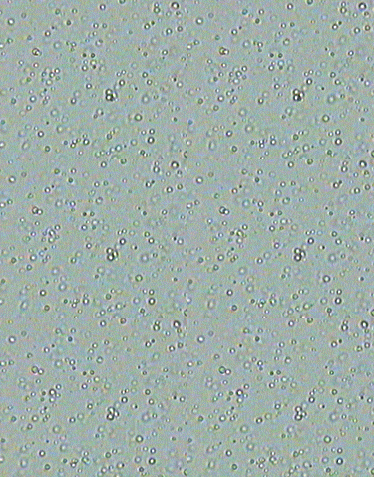
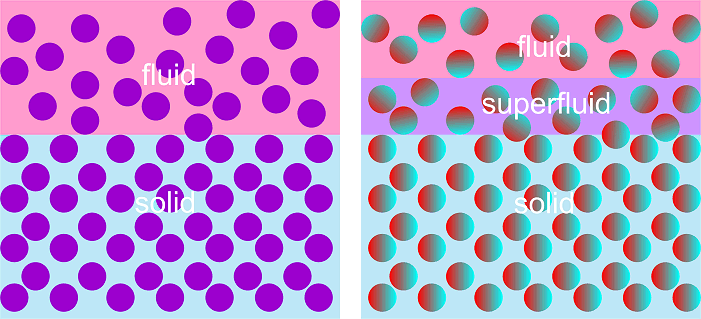
By AWT the supersolidity is a quantum analogy of liquid crystals or ice regelation. Did you notice, how fresh cold snow crackles and crunches under your feet? A supersolidity takes place here - just in quite limited extent, indeed. The trick is, the surface of helium-4 crystals isn't dry in certain range of low temperatures, as it's being covered by thin layer of molten superfluid helium, which lubricates them by the same way, like surface of snowflakes. In thin a few nanometers thick layers so called ballistic transport mechanism takes place. It can be called a "low distance superconductivity" of "low distance superfluidity". We can observe this in thin layers of graphene or semiconductors even at room temperature: the electrons aren't moving' continuously here, but in small jumps, during which they're behaving like boson condensate. This is a result of geometric degeneration of quantum wave, which is constrained in thin layer like particle in 1D box - so called quantum tunneling can take place here. A real sample of solid helium is presented bellow - it requires the temperatures bellow -272.2 ºC and over 40 atmosphere pressure to exists:


The same mechanism occurs in thin surface layers of snow or ice, where it is magnified by large number of crystalline particles involved. The fluid moves in thin quantum vortices along surface of crystals by mechanism, which is similar to domino effect. The same effect is responsible for anomalous slipperiness of ice and ice regelation. And of course, it occurs in solid helium in much more pronounced way, because of low temperature. It means, the fluid / solid mixture of helium crystals is not completely superfluous, but it responds to small deformations freely. But we can observe it even in another systems in smaller extent, for example the so called "tin cry" (sound sample) is the bulk phenomena of the same category.


The helium-4 differs from helium-3 in scope of supersolidity. Atoms of helium-3 are non-symmetric due the odd numbers of nucleons, which effectively means, ballistic transport remains constrained to surface of crystals and dislocations inside of frozen helium. The symmetrical atoms of helium-4 are adsorbed to these surfaces preferably, as they condense more easily - so they're killing the effect here like every impurity, which prohibits a free motion along surface of crystalline domains. The surface character of supersolidity in helium-3 manifests by limited temperature range, in which this remarkable effect can take place - at temperature bellow 1K the surface layer of molten helium freezes and supersolidity disappear. The water molecules are highly polarized in charge, so that the surface phenomena can take place in -52 ºC to 0 ºC temperature range, whereas some larger rod-like molecules are asymmetric up to level, they're forming a "liquid crystal" in the bulk phase even at highly elevated temperatures.


With compare to above systems, supersolidity of helium-4 is much more subtle phenomena, which occurs at lowest temperature range only, because of high symmetry of 4He atom nuclei. It manifests only at the moment, when number of crystalline domains becomes very high - it means inside of glass phase of helium, prepared by fast cooling. Such glass can be considered as amorphous phase with large amount of tiny dislocations, where the surface quantum phenomena become more pronounced due the large number of surfaces involved. Glass can flow rather quickly at nanoscale, which can be illustrated in experiments with fast healing of thin holes formed by ion bombardment. The flowing of glass is well known from limited lifetime of glass knives, used for ultramicrotomy or from healing of tiny glass cracks, which can be determined by fracture mechanics techniques. Because dislocations inside of glass phase are very small in size, the scope of ballistic transport is quite limited here, which results in "quantum jelly" or "superglass" behavior, rather then "quantum crunching".


These subtle phenomena can become quite significant even at large scales, as they can promote for example the formation of avalanches in mountain areas. It means, a subtle quantum surface effect, which applies to nanometer distances can kill people here due its cumulative effect over large number of particles involved. And this is basically, what the whole AWT is about.

Saturday, March 07, 2009

AWT and superconductive mirror for gravitational waves

This post is a comment of recent ArXiv article (via KFC) about concept of superconductive mirrors for gravitational waves. This is a bright and very interesting idea, fully consistent with Aether theory. Now we can rethink Le-Sage theory of gravity and all these “controversial” Podkletnov and Tajmar “antigravity” experiments from perspective of this concept immediately, because by AWT the Casimir and gravity force and inverse square law results from shielding effect of tachyon waves spreading in many dimensions and the shielding of these waves would result into shielding effects of gravity, i.e. antigravity anomalies observed in connection to superconductivity.

From AWT follows, the part of light waves passing through dense body, for example the interior of black holes will spread through it by superluminal speed, i.e. like tachyonic gravitational waves in analogy to wave spreading at water surface and underwater.

Therefore surface of black hole beneath event horizon should reflect light waves by the same way, like water surface reflects sound waves coming from underwater by total reflection mechanisms. This explains, why event horizon behaves like one-way mirror for energy waves. Only long wavelength portion of this radiation can penetrate event horizon freely in form of gravitational waves and so called Hawking radiation. Because observable universe can be interpreted as a dense cluster of black holes, this concept has a close relation to “cosmic hall of mirrors” models of Universe interior and to some observation of infrared-shifted reflections of remote objects, as observed by Spitzer telescope.

In addition, AWT considers high-pressure model of superconductivity, by which charge carriers are forced in chaotic motion due their repulsive interactions under mutual pressure, which are compensating mutually inside of charge stripes of HT superconductors. The asymmetric d-orbitals of transition metals (Nb) and hole stripes in diamond, cuprates or iron arsenides attracts the electrons up to level, their repulsive forces are mutually compensates, so that collective chaotic motion of electrons (superfluidity) can be achieved, which manifests itself like superconductivity.

Black hole are formed by highly compressed system of particles, which are forming superfluid condensate by similar way, like charge carriers inside of superconductors, so that every superconductor can serve as a low density model of black hole interior and it should reflect gravitational waves by its inner surface as well.

The above model brings an interesting analogy between formation of superconductivity induced by presence of hole stripes and black hole formation at the center of galaxies. By AWT superconducting phase appears at the center of hole clusters, because tiny particles (electrons) are mutually collapsed by attractive forces of larger objects (holes formed by atom nuclei). Analogously, black holes appears like vacuum condensate at the center of galaxies, because particle of vacuum are collapsed together here by attraction of larger objects - i.e. by stars near center of galaxy. If this model is right and dynamic equillibrium exists here, then the black hole should lose its mass, when thrown out from gallactic center for example by gravitational slingshot mechanism during galactic collisions - which appears a bit strange for me.


By relativity a black hole is formed, whenever event radius encircles a mass, the critical density of which exceeds Schwarzschild's criterion R = 2 GM. For large black holes critical density is relatively low and it could be achieved even by bulk density of massive bodies surrounding the center of galaxy. It would mean, the black holes can be formed automatically, whenever sufficient number of massive objects appears at proximity by the same way, like superconducting phase appears, whenever sufficient concentration of holes is reached inside of electron fluid. The lack of black holes at the center of small stellar clusters and dwarf galaxies supports this view partially.

AWT is not the only theory, which is considering a concept of tachyonic gravitational waves and black hole model of Universe on background. By holographic principle virtual particle excitations ("tachyon condensation") inside of vacuum can correspond virtual excitations inside of superconductors due the absorption of graviton waves in superfluid, forming the interior of black hole. These excitation should correspond massive particles, which we can observe around us. The more close comparison of AWT and holographic theory will be discussed in post dedicated to polarization and dispersion of gravitational waves later.

Anyway, I hope, these simple mechanical models could improve consistent understanding of concept, which Chiao's group has proposed.

Wednesday, November 26, 2008

AWT and the quest for HT superconductivity

The interpretation of high temperature superconductivity by Aether theory is surprisingly easy - so it's apparent, just the common skepticism in particle models in physics has caused, such interpretation wasn't considered before years already. The forces between highly compressed electrons are compensating mutually, which leads into chaotic motion of charged particles, where energy can propagate in waves only, i.e. via bosons, formed by foamy particle condensate. Such system is indeed difficult to handle by explicit formal models indeed - but ab-initio computer simulations of quantum waves of many particles should reveal this behavior without problem - it's somewhat surprising, they weren't made already even in context of existing theories.


Anyway, to prepare condensed electron system isn't so trivial, as the "slippery" electrons cannot be simply compressed inside of vessel by piston, because they can pass through matter rather freely. For this purpose we can use a positively charged atoms, which attracts the electrons like money thrown into crowd attracts the people - the moment, when people starts to fight for free access is an analogy of quantum chaos, which we want form in electron cloud. The hole dopant atoms in semiconductor lattice can play a role of bait for electrons: the large group of holes attracts neighboring electrons, so they condensing around them. This model considers, electrons can move rather freely through lattice:


Unfortunately, the formation of isolated islands of condensed electrons isn't enough for establishing of superconductivity. Instead of this, so called the pseudogap state is formed, when the material exhibits most of bulk properties characteristic for true superconductors, but still hasn't a zero resistivity - this behavior is still a puzzle for mainstream physics, although its interpretation is easy in AWT. The increasing of hole density in general leads to the decreasing of the pressure inside of spherical islands and formation of metallic state, which is non-superconductive in general (the metals with spherical Fermi surface aren't good in superconductivity in general). Instead of this, a highly asymmetric lattices are preferred here, which are enabling the formation so called hole stripes. Under proper doping level, a less or more continuous superconducting phase can be formed successfully. The relatively sparse superlattice character of YBaCuO mixed oxide structure provides necessary distance separation of hole stripes. Repulsive forces of electrons inside of stripes must remain balanced by binding forces of remaining atoms.

It's apparent, the true room temperature superconductors must be formed a 3D superlattice of holes, injected into material in nanometer resolution - which isn't so easy to produce by contemporary technologies inside of regular crystals. Foam character of electron condensate manifests by formation of double walled anti-parallel spin domains along hole stripes in accordance to Colin Humphreys theory. We can consider them as a product of many Cooper pairs condensation along hole stripes, so that BCS/BEC theories still have their common point here.
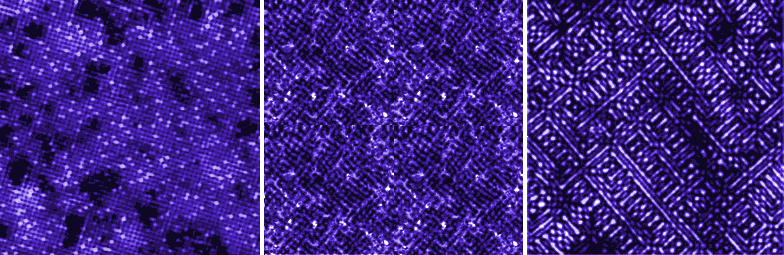
The increasing level of doping manifests itself by transition from semi-ordered anti-ferromagnetic state in which magnetic layers are interspersed with non-magnetic layers. When the doping level is increased, magnetic ordering is suppressed on behalf of chaotic Fermi fluid near hole stripes and pseudogap in volume phase manifests itself. When the doping level increases even more, the pressure of neighboring atoms and degree of electron condensation may not be sufficient to maintain chaotic state anymore and the superconductor goes to metallic or even nonconducting state again. Bellow is the example of fractal principle, in which hole superlattices can be produced from ceramic precursors.

The surprising consequence of Aether model of HT superconductivity is, formation of superconductive phase isn't restricted just to solid phase. The electrons can condense even along surface of doped semiconductors, thus forming a superconductive channels around it. In such case, the formation of superconductive phase is even much more easier due the absence of atoms, prohibiting in electron free motion. It's virtually whole new approach to superconductivity at all.


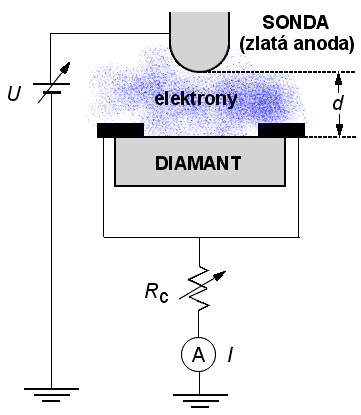
Surprisingly enough, this mechanism was already revealed by prof. Johan F. Prins in 2002, who studied ion injection into diamonds (NS article, refusal). The n-doped diamonds are known for their very low work function due the strength of covalent C-C bonds. Therefore n-doped diamond binds a redundant electrons weakly and it can serve as a material for cold discharge cathodes, for example. At the moment, some oxygen ions are injected into diamond lattice by using of high voltage discharge, the hole atoms are attracting the surface electrons by such a way, they create a superconductive channels at the surface of diamond, which can be manifested both by zero resistivity in micrometer scale, both by Meissner-Ochsenfeld effect, because the surface of plasma treated diamonds repels the magnetic micro-particles reportedly.


Surprisingly these fundamental findings have met with rather low attention in scientific community so far, probably due somewhat dissenter approach of prof. Prins toward mainstream science, the quantum mechanics and BSC theory in particular (1, 2 -the fact, some theory cannot be applied to particular situation doesn't always mean, this theory is wrong). We can met with the same situation here, like at the case of Heim theory, antigravity or cold fusion research: the hysteresis of skepticism and peer-review based approach of mainstream science isn't very good in separation of progressive ideas from these crackpot ones. Of course, the delays in research resulting from pathological skepticism are of the very same cost, like the false belief in void speculations - they just cannot be calculated by explicit way.