Showing posts with label gamma rays. Show all posts

Monday, August 24, 2009

AWT and GRB090510 photon controversy

This story was discussed extensively on Bee's and LuMo's blogs. In brief, recent observation of very remote (12.8+ Glyrs) gamma ray burst GRB090510 observed by Fermi observatory (former GLAST satellite) was followed by another lone gamma ray photon of extraordinary high energy (31 GeV), detected be terrestrial observatory MAGIC (Major Atmospheric Gamma Imaging Cherenkov) in the same moment (six seconds window of the whole three minute burst).

While string theory (ST) is based on LS, this result was interpreted by Motl as a confirmation of ST, although in fact it confirms the validity of one of string theory postulates only. Although gamma ray dispersion was considered as one of main tests of quantum gravity theories and the picture bellow was presented in many places, LQG theory in its current state of development has nothing to say very much to this result, because it maintains LS in 3D in the same way, like string theory, as Lee Smolin explained. This picture is a snapshot of article in Scientific American, 59: "Atoms of space and time", which is definitelly worth reading by itself - but it contains desinformation, concerning LQG predictions.


Phenomenological explanation of this controversy is simple in AWT and it's based on the fact, LS is valid only for strictly 3D space, whereas cosmic space is filled by gravitons expanded into gravitational waves during inflation, i.e. tiny density fluctuations responsible for cosmic microwave background (CMB). Therefore cosmic space isn't completely "flat" and it contains "traces of higher dimensions". While LS is indeed valid for all higher hyperspaces, their projection into 3D space isn't invariant with respect to LS anymore. From AWT follows, only microwaves can propagate through vacuum like harmonic wave, thus fulfilling LS at long distances, while longer waves are propagating like tachyons and shorter waves are always composed of photons, which are propagating by subluminal speed. This dispersion can be observed in GZK limit for gamma ray photons and it manifests by delay for gamma ray photons during weak (short distance) gamma ray bursts, like MKN501 event, observed last year. In accordance with this explanation, the dispersion of more close gamma ray flashes is usually much more pronounced, then at the case of these remote ones.

As a pronounced example of light dispersion during spreading through compactified gradient can can serve Hawking radiation of black holes, which can be interpreted like light escaping from glass sphere. Long wavelengths and gravitational waves can penetrate it freely, whereas shorter wavelengths are reflected back again by total reflection mechanism


The reason, why GRB090510 burst (and some others, like GRB 080916C from September 2008) didn't exhibit a pronounced dispersion consist in point, such bursts were very remote and as such they were quite energetic - an energy corresponding mass of Sun is released in form of gamma photons in brief moment! In AWT dynamic mass of photons manifests by real mass with gravitational effects, not just a combination of momentum and kinetic energy, as presented by mainstream propaganda. This is because in AWT photon has a nonzero rest mass, albeit quite minute one. Therefore the gamma ray burst propagates through vacuum like dense cluster of photons, tied their own gravity, or like soliton, similar to vortex rings, which can propagate through fluids and gases without dispersion.
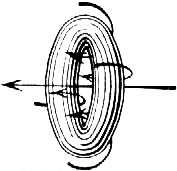


The slowing of ligth in boson condensates is based on the fact, EM wave is spreading in form of much heavier electrons, which are revolving around atoms for most of time. Neverthelles the appearance of single photons in vacuum should correspond the appearance of solitons (quantum vortices) in boson condensates.


Because wave packet cannot contain only fraction of wave (it would violate the eigenvalue postulate of quantum mechanics) both wavelength of light, both size of wave packet is compressed in the same way and the shape of vortices in boson condensates is pretty close to appearance of real photons in vacuum - it's just greatly reduced in scale along path of direction.

The cluster of photon ("photoball") is analogous to glueballs, known from weak force scale and it can serve as a prototype of heavier elementary particles. It's formed by dense swarm of photons, where the most energetic and heaviest photons are propagating at the center, while these lightweight ones are revolving center of soliton along substantially longer path, which corresponds the segregation of matter by particle density at the case of massive bodies. This could have testable impact to the distribution of energies along time axis of gamma ray flash: heavy photons should appear at the center of Gaussian curve, representing the gamma burst observation.

Because photons influence mutually at distance in this model, it may be even possible, the lone photon observed in GRB090510 was actually trapped into gamma ray flash during its travel through wast cosmic space, or it could serve as its condensation nuclei in similar way, like particle of dust enables molecules of water to condense into droplet. It would mean, the occurrence of photons of unexpectedly high energy density inside of gamma ray flashes isn't accidental at all and such model leads to another testable predictions concerning gamma ray photons distributions. The "snowball" mechanism of avalanche-like photon trapping has its analogies at the case of rain or snow condensations, laser pumping or rise of Hitler's power before WWW II.

Because photons inside are moving independently to motion of soliton, they're propagating in hidden dimensions effectively: we can say, higher dimensionality of space-time, i.e. symmetry breaking of mass density (inhomogeneity) converts into higher dimensionality of particle motion during sufficiently large space-time interval, i.e. into symmetry breaking of energy density (dispersion). The same mechanism of composite particle formation can be applied onto every other heavier particles or even objects in social systems. All elementary particles are propagating through space like solitons, composed of smaller bosons, which can be illustrated for example by relation of spin projection into axis of motion to speed of particle. The escape of particles through polar jets of black holes can be considered as an exagerrated case of soliton mechanism.
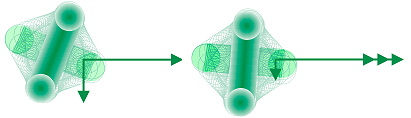


Concerning LS violation, we aren't disputing a lone photons, the exact path of which is unavailable for us - but cluster of photons as a whole, which is indeed quite different situation: at the scope of such cluster individual photons may move randomly along different paths - while they're still keeping the shape of cluster as a whole. Therefore LS remains maintained at the cluster level with respect to dispersion, thus leaving postulates of string or LQG theory intacted - but whole cluster is still moving in subluminal speed with respect to lone microwave photons, so that even lightweight neutrinos can move faster in certain cases. Atemporal logics of formal math, used in these theories cannot handle such situation easily, because of collective motion of many objects at the same moment - although it's still quite trivial to understand. For example, while theories like DSR/DSR2 proposed by Smolin and Maguejio consider violation of LS less or more successfully in 3D, they still cannot explain "violation of LS violation" at both large distance and large energy density scales, which is indeed the case of gamma ray propagation across whole Universe.

String theory could easily model violation of Lorentz symmetry in inhomogeneous 4D space-time simply by declaring it a higher-dimensional flat space in the same way, like LQG - the only problem is, scientists on both sides of ST/LQG duality still didn't realize it, while they're still seeking for signs of both extradimensions, both Lorentz symmetry violation - although they have them before eyes all the time. In addition, here exists an interesting deadlock mechanism: string theorists (ST) could introduce Lorentz symmetry (LS) violation by considering of extradimensions, but they hesitate to propose it, because LS belongs between ST postulates in 4D space-time, while LQG proponents could introduce extradimensions by considering Lorentz symmetry violation, but they grudge against it, because they proposed LQG a just "4D theory" originally.

At the moment, when both sides are earning half of grant support, no one wants to start the reconciliation of both theories by considering of ideas of the dual theory. In such a way both sides are effectively locked inside of ivory towers of their own prejudices. I presume, this example situation explains a lot, how symmetry breaking is occurring at phenomenological level and it illustrates clearly, why theoretical physicists should be payed for reconciliation of existing theories be decreasing of number of postulates, instead of for development of new ones by increasing of number of existing postulates, because divergent character of their formal thinking prohibits them in reconciliation of existing theories.

Sunday, April 19, 2009

AWT and ultra-energetic cosmic rays

This post is an reaction to New Scientist article named "13 things that do not make sense", which was updated recently. Ultra-energetic cosmic rays (UHECR) are exceptional from two reasons:
  1. They're most energetic spouts of energy known so far, i.e. of energy densities which becomes close to upper limit of GUT scale.
  2. They're propagating over whole universe, i.e. at space-time distance scales close to lower limit of GUT scale.
These two properties enable us to observe 2nd order phenomena, which are not just violating the classical theories - but they're even violating some of their corrections. For example, while special relativity considers, light spreads in constant speed, the cosmic rays exhibits a dispersion on CMB field, which results into violation of Lorentz symmetry, because gamma ray photons spreads in lower speed, then the CMB ones. As the result, gamma rays are absorbed in CMB field at 40 MPsc distance scale, which manifests as so called the GZK limit, which protects terresterial life from gamma rays from nearby supernovae explosions. This dispersion can be even detected directly, because gamma ray flash separates from those formed by visible light during explosions of supernovas - compare the MAGIC observation, for example.

The above is valid just from moderate gamma ray flashes, generated in stellar implosion or collisions. UECRS, which are coming from very distant areas of Universe (fortunately) are formed mostly by collisions of galactic black holes (AGN) and as such they're propagating like bullets or solitons through cosmic space - which effectively means, both visible, both gamma ray portion of remote flash arrives to Earth at the single moment again. The photon pulse of UHECR is distorted and breaks up by its own gravity, condensing into one or more gravitationally localised objects, which are propagating through distant space as a single body without dispersion.

This behavior is essentially welcomed by some string theory proponents, because string theory is basically a particle theory, not a field theory, so it can describe nonlinear effects connected to particles by hidden dimensions concept - but it gets into troubles when explaining of nonlinear field phenomena, like Lorentz symmetry violation in vacuum (being Lorentz symmetry based theory). Various quantum gravity theories - the LQG theory in particular - are dual to string theories from certain perspective, so they become a more successful in description of nonlinear properties of vacuum. This is particularly because the quantum gravity theories are based on combination or general relativity and quantum mechanics, not just a special relativity and quantum mechanics, like string theories - so they can become a bit more general in this point. The soliton behavior of UHECR is explained by various mechanisms, like the axion–photon conversion or by gravitino-neutrino coupling.

By AWT the observation of UHECR can be explained by considering of three facts, which follows from AWT rather directly. The first two points explains, why existing mechanism of gamma ray formation may lead to more energetic flashes, then current theory predicts. The third point explains, why such energetic flashes doesn't suffer gradual dispersion, so we can observe them even over whole universe.
  1. The collapse of neutron stars into black holes enables a substantial portion of matter to escape in form of energy
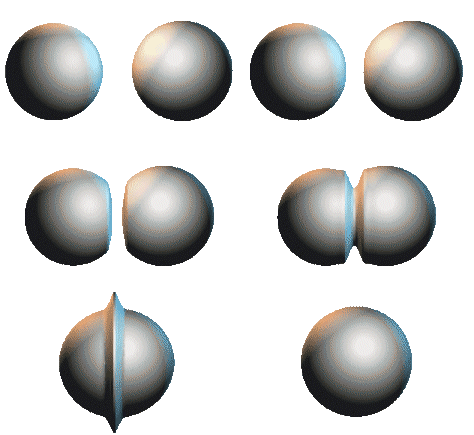
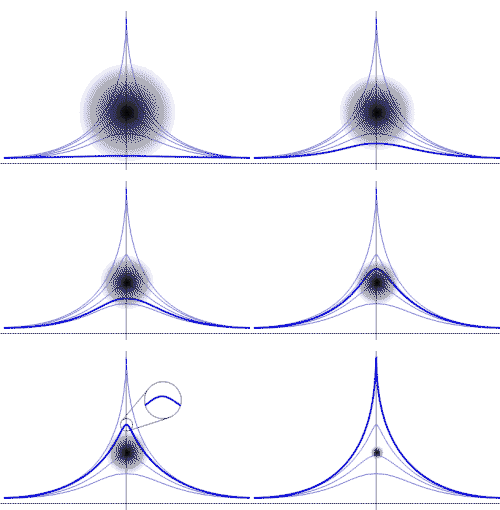
  2. The black hole merging exhibits an hysteresis due the surface tension effects of space-time curvature, similar to merging of mercury droplets.
  3. The short intensive flashes can propagate at long distance in non dispersive way, i.e. like solitons.
From AWT follows, every gradient manifest itself by mass/energy density, even the gradients of gravity field, which is source of spacetime curvature, which surrounds all massive bodies. This behavior leads to supersymmetric phenomena, which manifest itself as a dark matter clouds surrounding massive galaxies. At the case of black holes or large clusters of elementary particles (strangelets) the gradient of gravity field is especially pronounced and it has a character of surface tension of mercury droplets. It means, the merging of black holes isn't so smooth, as follows from unmodified equations of general relativity - black holes tends to form a relatively stable dense clusters, similar to strawberries. We can observe these structures from inside like foamy streaks of dark matter. The same surface tension effects of gravity field curvature are responsible for creation of tetraneutrons, or perhaps pentaquark or more large particle clusters, so called the strangelets during collider experiments.


Merging of black holes considers the formation of thin neck with negative curvature of space, which manifest itself by repulsing antigravity force. By classical theory the antigravity action results into increasing of rotational momentum, which slows down the coalescing of massive bodies into account of gravitational waves (the energy of transversal waves converts into longitudinal ones in process of symmetry breaking). At the moment, when surface tension is overcomed, the black hole coalesce under release of activation energy, which is released in form of longitudinal gravitational waves and transversal waves of gamma radiation.


Even the tiny mercury droplets (which are full of free electrons) exhibits a repulsive force at the distance, which prohibits them in merging due their surface tension. Thus is because their merging requires the formation of thin neck with strong negative curvature, which is always source of repulsive force in nature. At the moment, such droplet will become very close, a suddenly merging occurs, because the negative gradient will change into positive and the repulsive force will change into attractive one. It means, the process of ultra-dense massive bodies proceeds in much more vigorous way (i.e. atemporarily from outer perspective) under radiation of much more energy in both transversal (gamma ray), both longitudinal (i.e. gravity) waves, then relativity theory predicts.


This behavior is in fact the consequence of Aether theory driven by classical mechanics, by which the most pronounced gradient of gravity field remains at the surface, not at the center and it manifests by its own energy density (surface energy). Albeit the mercury droplet behavior of free electrons isn’t very pronounced in metals, it dictates the behavior of chemical bonds between atoms during chemical reactions and charge transfer in semiconductors, which can be interpreted by mercury droplet model in many cases.

Sunday, February 22, 2009

AWT and gamma ray dispersion

Markarian (Mkn) 421 and Mkn 501 are two relatively nearby (z=0.034) galaxies about 300-500 light years (0.5 Gly) away. Mkn 501 is a bright optical object (blazar) in the active galactic nuclei (AGN) of a giant elliptical (young) galaxy, containing probably black hole binary, which exhibit the high energy cutoffs predicted to be the result of intergalactic annihilation interactions, primarily with infrared photons. In accordance with this, a MAGIC telescope collaboration published an observation of 30 sec delay of two minutes lasting 10 TeV gamma ray gamma ray bursts (GRB) from summer 2005 with respect to low energy signal, i.e. high energy tail, which On the origin of highest energy gamma-rays from Mkn 501 can be explained by intergalactic cascade of gamma rays. Without presence of external gravity/magnetic field it could be explained by several models of quantum gravity as a result of dispersion of gamma rays by quantum foam structure of vacuum in 1o+7 eV scale.


With compare to this, the GZK limit considers dispersion by CMB photons at 1o+19 eV scale only. It was proven by recent 16 seconds lasting huge burst GRB 080916C from September 2008, as observed by Fermi / GLAST observatory which is working at 300 GeV scale, during which six-second delay separating the highest-energy emissions (red) from the lowest (white dots) was observed. The distance was estimated by wavelength of afterglow drop-off caused by intervening gas clouds (afterglow photometric redshift) to 12.2 Gly (z=4.35), which places GRB 080916C among the top 5% most distant GRBs, and makes it the most energetic GRB known to date.


While these results were interpreted by string theory proponents as a negative result of Lorentz symmetry violation immediately, we should realize, dispersion is exponential function of wavelength, the energy scale of Fermi/GLAST observatory is 30x lower, then MAGIC observatory and the GRB event was 8x shorter - so that the five-times shorter delay is still comfortably acceptable here. But if we still consider, GRB 080916C was 25x more distanced, then Mkn 501 blast it's apparent, the mechanism of high energy tail is still the same, i.e. of intergalactic origin, not a result of gamma ray photons dispersion in extragalactic space without presence of magnetic and gravitational fields.

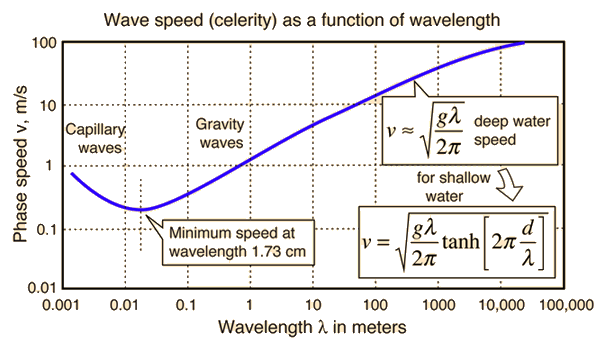
By AWT this behavior is a consequence of nonlinear behavior of Aether foam (compare some ad-hoced QG models) and the same phenomena we can met at the water surface, where waves of different frequency are moving by different speed (compare the celerity curve), but burst propagates here at large distance like self-reinforcing solitary vortex ring or wave packet, i.e. the kink soliton. For soliton is typical quantization and fragmentation of time arrows (analogous to splitting of event horizon in Kerr metric of rotating black holes). When a wave is too big for the depth of water, it splits into two, one big and one small, which continue independently, i.e. no dispersion occurs here, until whole pulse propagates like single wave packet described by Sine-Gordon/Klein-Gordon wave equation (compare the "rubber band" model of soliton and/or special relativity). All particles including neural waves are sort of hyperdimensional solitons, while these of non-zero rest mass are so-called "breathers".


Soliton character of gamma ray bursts is the reason, why we can observe them at all without apparent dispersion even at cosmological distances, thus violating the Greisen-Zatsepin-Kuzmin limit and they can explain, how X-ray or gamma-ray luminosities are related to peak energy output or the luminosity at lower frequencies alternativelly to dual axion models (axions or gravitophotons are vortex analogy of burst solitons by AWT). In accordance with this apparently weaker burst of AGN Mkn 501 exhibits more apparent dispersion assigned to ALP mixing (i.e. axion coupling), then the sharper GRB 080916C, which exhibits Gaussian distribution, typical for solitons. By this way, AWT can explain even violation of Lorentz symmetry violation, i.e. 2nd order violation of relativity, which manifest itself only during spreading of cosmological energy densities at cosmological distance, thus doubly fooling some special relativity and/or string theory fundamentalists.