This post is a reaction to recent NS article "
Missing dark matter mystery in small galaxies". It's
well known, large galaxies and galactic clusters are relatively abundant to dark matter with compare the smaller ones. This finding could have certain meaning in
AWT cosmology, in which large gallaxies were formed by evaporation of central black holes, whereas smaller ones were formed rather by accretion (i.e. by classical mechanism with respect to contemporary cosmology). Another ideas presented in connection with this model was
dark star origin of gallaxies and the
shielding effect of dark matter. This effect is understandable with respect to AWT mechanism, because of large content of
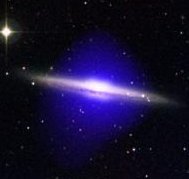
antimatter considered in dark matter, which could have antigravity action at large distances. Presence of heavily ionized atom nuclei trapped makes dark matter detectable by X-ray telescopes, like Chandra.
It would mean, dark matter is in fact super-symmetric effect of black holes inside of galaxies. Without presence of central black holes the galaxies cannot contain material particles around it, because of no evaporation. This idea could have some meaning in holographic theory of Universe, too. This could explain both absence of dark matter outside, both black holes outside of small galaxies.
But the whole subject is still quite speculative in this moment and additional observational data are required. Recently Hubble
has found another evidence of dark matter presence near small galaxies.
This study demonstrated, that the low-velocities of stars observed around dwarf galaxies are infact compatible with galaxy formation in dark-matter haloes. Stellar orbits in the outer regions of the resulting elliptical are very elongated, which can explain the observed velocities even in the presence of large amounts of dark matter.


 Posts
Posts


3 comments:
Heavy photons are too light to be behind dark matter. Heavy photons are one of few dozens of less or more theoretical concepts, which are attributed to existence of dark matter. I ordered them by their average rest mass, which differs in twenty(!) orders of magnitude: scalar field, quintessence, mirror matter, axions, inflatons, heavy photons, fat strings, sterile neutrinos, chameleon particles, dark fluid and dark baryons, fotinos, gravitinos and WIMPs, SIMPs, MACHOs, RAMBOs, DAEMONs and micro-black holes. And I probably missed many others...
In 1974, theorists William Press and Saul Teukolsky noted that if a black hole were spinning fast enough, light of a long-enough wavelength passing close by would scatter off it, rather than being sucked in. If this spinning black hole were to be surrounded by something like a mirror, the light could be reflected and scattered many times. Fuelled by energy from the rotation of the black hole, it would bounce back and forth and amplify itself in a runaway process rather like what happens in the mirrored cavity within a laser. If the surrounding mirror were removed or shattered, the light would instantaneously escape in a powerful burst of light and heat – a black hole bomb. Abraham Loeb thinks the primordial black holes might provide an identity for dark matter.
I'm sorta confused with this stance, because the primordial black holes were already considered (and never found) as a significant component of dark matter with Randall and Sundrum before twenty years. But these primordial black holes are assumed to be rather small and in AWT they simply correspond the atom nuclei. If Leob thinks about black holes residing at the center of galaxies, then this idea becomes more relevant, because in AWT the galaxies are formed with collapse of dark matter (neutrinos and photons) into quasars and recycle the matter and radiation released with previous generation of galaxies in this way. It would mean, these ideas converge to AWT models, but they're still limited by their adherence on Big Bang cosmology. If you imagine, how such cloud of dark matter collapses into galaxy, then the above idea gives sense for AWT, when concept of multiverse is taken into account. This moment will represent the nucleosynthesis and atom formation from dark matter - we just need to imagine it like the process widespread around quasars across observable universe. Another article in Nature openly presents the Press & Teucolsky mechanism as an evidence of impossibility of primordial black holes survival (the electron plasma should form an amplifying mirror for the photons bouncing around a black hole).
So, now it seems, the physicists did throw the concept of primordial black holes into bin. When they will realize, that these microblackholes are stabilized with extradimensions and they actually represent the common hadrons and atom nuclei formed during nucleosynthesis, they will be forced to reinvent and bring it back.
IMO the level of conceptual confusion in mainstream physics just passed its historical supremum. The physicists already realized, that their simplistic models don't work well, but they still didn't realize, here are alternative interpretations of these models with existing artifacts, which are indeed much more complex, than that - but their similarity is still apparent.
Great bloog
Post a Comment